In shortDay trips from Hallstatt run through Bad Ischl, the valley's bus hub: the ride between Bad Ischl and Hallstatt, Obertraun or Gosau takes 40 to 50 minutes, with the last bus out of Bad Ischl at 18:16. Obertraun, across the lake, holds the Dachstein caves and the Krippenstein cable car, daily to 1 November 2026. Allow a full day there, half a day for Bad Ischl.
40–50 minBad Ischl to Hallstatt by bus
18:16last bus from Bad Ischl
365 daysstation ferry in service
1 May–1 Nov 2026Krippenstein summer season
Where the day trips from Hallstatt go
Almost every bus route in this corner of the Salzkammergut pivots on Bad Ischl, roughly 20 km north of Hallstatt. Line 150 links Salzburg Hauptbahnhof with Bad Ischl hourly, at times every half hour, and terminates there. From Bad Ischl, line 541 heads down the valley to the stop 'Gosaumühle', where you change to line 543 for 'Hallstatt Lahn', and the same 541 continues on its own to Gosau and the Gosausee. Lines 542 and 543 serve 'Obertraun Dachsteinseilbahn' on the far side of the lake. Between Bad Ischl and Hallstatt, Obertraun or Gosau the ride takes about 40 to 50 minutes in either direction, and Bad Goisern is about 20 minutes out of Bad Ischl.
The hard limit on any of these outings is the evening. Whatever you plan, 18:16 is the time that decides it: that is the final departure of the day from Bad Ischl station towards Hallstatt, Obertraun, Gosau and Bad Goisern, and nothing follows it, so you lay out the day backwards from that bus. On line 150 the extra weekend buses appear only from May to September and on Advent weekends, with up to four departures an hour at peak on the Salzburg–St. Gilgen stretch from 14 September 2026, which matters mainly if your outing begins or ends in the city.
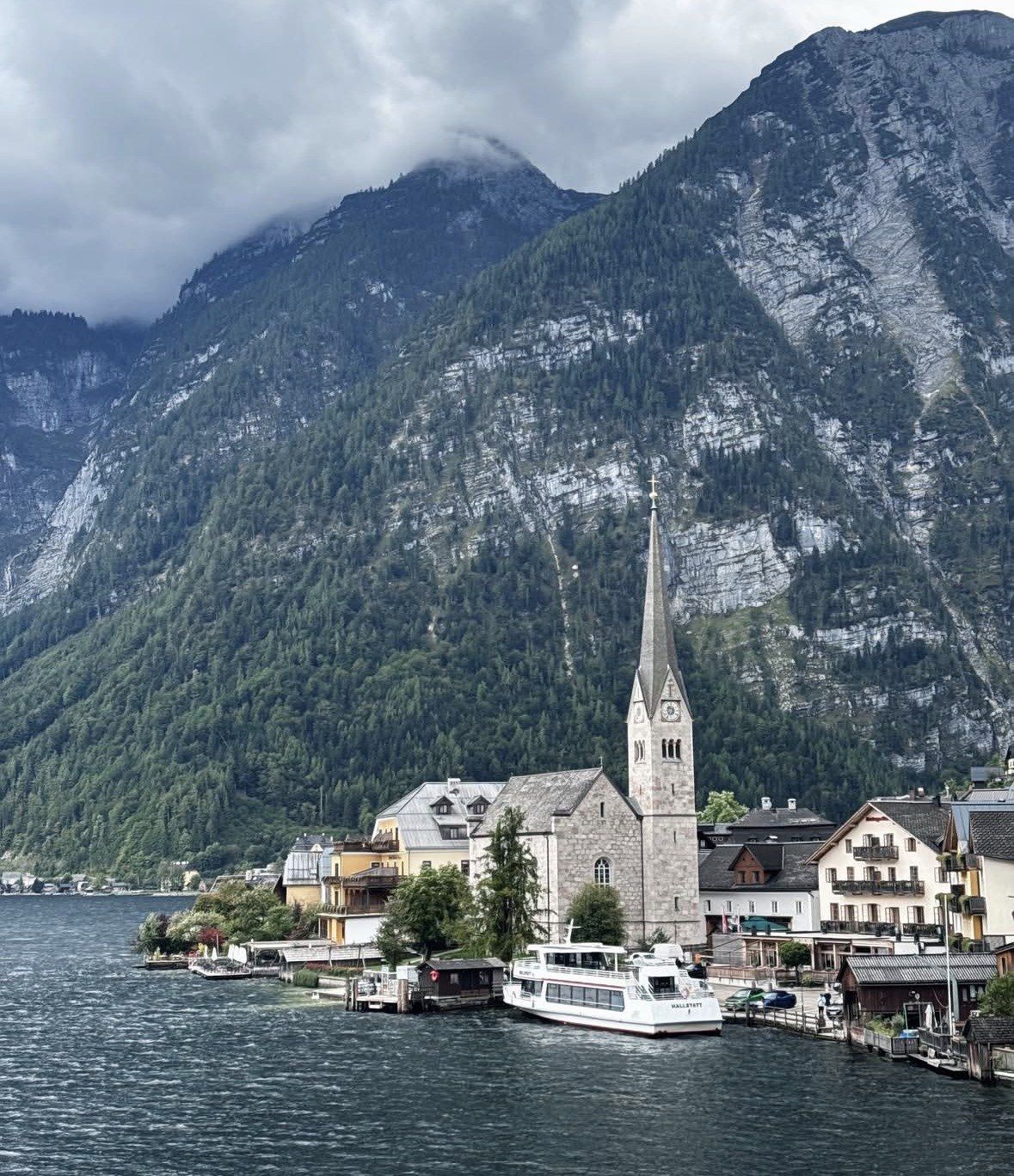
By rail the picture is thinner but useful for Obertraun: Hallstatt station sits on the opposite, east shore of the lake, trains on the Attnang-Puchheim–Stainach-Irdning line call roughly every two hours, and about five direct services a day run between Obertraun and Hallstatt station. Two minutes downhill from the platforms you reach the pier, and the crossing back to the village takes about 15 minutes on Hemetsberger's MS Stefanie, which sails on every date in the calendar and is timed to the trains. The operator calls it the only ship connection on an Austrian lake that keeps working through winter, so a day out by rail still closes properly in February. Check timetables on the day you travel; the bus and boat schedules are published season by season.
| Where | Getting there from Hallstatt | How long to allow |
|---|
| Bad Ischl | Bus 543 to Gosaumühle, then 541, about 40–50 minutes | Half a day; the villa is seen on a guided tour of about 45 minutes |
|---|
| St Wolfgang (Wolfgangsee) | Bus to Bad Ischl, then line 150 to Strobl and a change to line 546, about 15 minutes on the last leg | A full day; the cog railway takes about 35 minutes each way |
|---|
| Obertraun | About five direct trains a day from Hallstatt station, bus 542 or 543, or the May–September boat | A full day for the caves and the Krippenstein plateau |
|---|
| Gosau and the Vorderer Gosausee | Line 544 or 543 to Gosaumühle and change there; from Bad Ischl line 541 runs through without a change | Half a day, or longer with the cable car; walking round the water is 4.2 km and takes about an hour |
|---|
| Bad Goisern | On the Bad Ischl road, about 20 minutes by bus from Bad Ischl | A short stop rather than a day |
|---|
Half a day from Salzburg
If Hallstatt itself is the trip and the lake district is for another time, this 5.5-hour guided coach from Salzburg handles the 75 km each way, from €85 and rated 4.4 ★ (1182 reviews).
★ 4.4/5 · 1,182 reviews
Bad Ischl and the Kaiservilla
Bad Ischl is the spa town where the Habsburgs spent their summers, and the Kaiservilla with its park is the reason to go. The interior can only be seen on a guided tour lasting about 45 minutes. From May to September the villa is open daily 09:30 to 17:00 with tours running from 09:45 to 16:45; in April and October it is daily 10:00 to 16:00. Outside those months the calendar gets thin: February is Tuesday to Saturday 11:00 to 15:00, March runs Wednesday to Saturday and then daily from 28 March, and November has only 28 and 29 November plus the Advent weekends, with a short run from 26 to 31 December. The park is sold separately from the villa, so a grey afternoon can still be spent under the trees.
Half a day covers it comfortably: 40 to 50 minutes on the bus each way, 45 minutes inside the villa, and time for the park and the town. Bad Ischl is also where you wait if you are connecting onward to St Wolfgang or Gosau, which is why it works better as the first stop of a longer day than as an afternoon squeezed in after the salt mine.
Weather makes this the sensible rainy-day trip. The Bad Ischl area averages 1,692.8 mm of precipitation a year, with an annual mean temperature of 9.8 °C in 1991–2020 against 8.5 °C in 1961–1990 and 11.8 °C in 2024, the warmest year on record there. A guided tour indoors beats a cable car you cannot see out of. On 12 December 2026 the Hand.Werk.Haus in Bad Goisern, 20 minutes down the road from Bad Ischl, holds its Master Advent from 10:00 to 18:00.
St Wolfgang and the cog railway up the mountain
St Wolfgang is the pilgrimage village on the Wolfgangsee, over the hills to the west, and the Schafbergbahn climbs straight out of it. The rack railway runs daily from 25 April to 1 November 2026, covering 5.85 km and 1,190 vertical metres to the mountain station at 1,732 m in about 35 minutes, with the Schafbergalm halt at 1,364 m reached after about 30 minutes. Trains of this kind fill up in July and August, and the summit is exposed; clear air is the whole point of going up.
Getting there from Hallstatt is the longest of these journeys. You travel to Bad Ischl first, then take line 150 towards Strobl and change at Strobl bus station to bus 546, the last leg of about 15 minutes into St Wolfgang. Treat it as a full day, and work the return around the 18:16 departure from Bad Ischl, because nothing follows it down the valley. If you want both the village and the mountain railway without that pressure, this is the trip to do on a day you are travelling in or out of the region anyway rather than from a Hallstatt base.
Across the water: the caves and the cable car
Obertraun lies at the south-east end of the Hallstättersee and answers to Dachstein Tourismus AG at Winkl 34, a different company from Salzwelten up on the Salzberg, so none of its dates follow the village. Set the date inside the operator's own summer window: daily service from 1 May to 1 November 2026, the first cabin up at 08:40 and one every quarter of an hour after that, the Gjaid section joining only from 4 June and the season finale falling on 27 October. For a winter outing the dates move to 19 December 2026 until 29 March 2027, section 1 turning from roughly 08:30 to 16:50 and the lifts from 09:00 to 16:00. Pick a day in early November or the first half of December and you will reach a valley station with no cabin to board.
Two very different outings share the same valley station. Both show caves, the Ice Cave and the Mammoth Cave, are guided-only, and you put your name down in person at the cave ticket office at the Schönbergalm mid-station rather than beforehand, so leave slack in the day for the wait; children born in 2020 or later travel free with a parent when you can produce proof of age. Higher up, the 5fingers is five platforms of about 4 by 1 m pushed out over roughly 400 m of air, an easy 20 to 30 minute walk from the mountain station, one deck carrying a large Baroque picture frame aimed down at Hallstatt, with the World Heritage spiral on the 2,100 m summit about 15 minutes from the top station.
Obertraun needs a day of its own. In clear weather go up for the plateau and the platforms; in cloud or rain stay with the caves, which are weather-proof but guided only. Reaching the valley station is simple: about five direct trains a day from Hallstatt station, buses 542 and 543 to 'Obertraun Dachsteinseilbahn', the train stop Obertraun-Dachsteinhöhlen, or a car park with 200 spaces, five of them for disabled visitors and twelve for buses. From May to September the sightseeing Round-trip South also links Hallstatt Markt and Hallstatt Lahn with Obertraun. Walkers can make the approach part of the outing: stage 16 of the BergeSeen Trail covers the ground from Hallstatt railway station to Obertraun at 513 m in about 45 minutes, while the whole east-shore Ostuferwanderweg adds up to 9.7 km with a quoted time of 2 hours 36 minutes and is open from April to November.
Gosau, Bad Goisern and the road north
The Gosau valley opens west off the lake road and ends at the Vorderer Gosausee under the Dachstein. An hour of walking takes you right round the water: 4.2 km on the level at roughly 940 m, graded very easy, out and back from Gasthof Gosausee. Arriving by car you have 516 spaces at the lake to aim for, two of them for disabled visitors and seven for buses. The walking season is May to October: in winter the path is neither cleared nor secured and the regional board advises against it because of avalanche and rockfall risk. Above the valley the Gosaukammbahn runs to the Zwieselalm daily 08:15 to 17:00 from 9 May to 3 July 2026, 08:15 to 18:00 from 4 July to 13 September and 08:15 to 17:00 from 14 September to 1 November 2026.
Setting out from the village means one change: line 544 or 543 as far as Gosaumühle, then the connection on to Gosau and the Gosausee. Anyone already in Bad Ischl has the easier ride, because line 541 goes through Bad Goisern to Gosau and the lake without a change at all. Half a day is enough for the lake and the circuit, a full one if you add the cable car. Winter changes the valley's purpose entirely: Dachstein West in Gosau plans to open for the season on 4 December 2026, the FreeSports Arena on the Krippenstein on 19 December 2026, and the Gosau Mountain Christmas Market is a single afternoon, 28 November 2026 from 11:00 to 18:00.
North of Bad Ischl the valley strings together the smaller towns on the Salzburg road. The official car route from Salzburg leaves the motorway at the Thalgau exit and runs via Hof, the Fuschlsee, Bad Ischl and Bad Goisern, about 75 km and roughly 1 hour 1 minute end to end, and line 150 follows much of the same ground through St. Gilgen. If you are in the region in late November, the Mill Advent at the Anzenaumühle runs 21 and 22 November 2026 from 10:00 to 17:00. Drivers should remember that a vignette is required before entering Austrian motorways and expressways, though the A1 is toll-free between the Walserberg border and the Salzburg Nord junction.
Building a two- or three-day plan around Hallstatt
The case for using the village as a base rather than a stop sits in the counts: roughly 1.2 million visitors passed through in 2025 while overnight stays came to just over 130,000, and the deputy mayor put day-visitor numbers in 2026 at about 10% lower. The lanes are quiet before 10:00 and after 17:00, and the ferry still runs at both ends of the day, while the bus out of the valley has already gone by 18:16.
Two days gives you the village and the Salzberg on one, Obertraun on the other. Three lets you add Bad Ischl with the Kaiservilla and, if the morning is clear, the Gosausee circuit on the way back. Do not try to stack Obertraun's cable car and caves onto a salt-mine day: the two mountains are run by different companies with different seasons and different closing times, and you would see both badly.
Travellers coming in from a city usually make Hallstatt itself the organised day and keep the lake district for later. The Salzburg option that leaves the rest of a day free for Bad Ischl or Gosau is the Hallstatt Half-Day Tour from Salzburg: a guided coach of 5.5 hours, from €85, 4.4 ★ (1182 reviews), setting off from the bus terminal at Mirabellplatz, corner Hubert Sattler Gasse 1 in front of St Andrew church, with entrances in the village optional and settled on the spot and an hour given to the Skywalk. Vienna is far enough that one long day usually stands in for the whole region: the Hallstatt Guided Day Trip from Vienna With Skywalk Option fills 13 hours, from €71 and rated 4.6 ★ (1482 reviews), guided live throughout, taking in the old town on foot with the Skywalk entrance covered outside the winter break from 07.01.2027 to 29.01.2027. From Munich, the private day trip to Salzburg and Hallstatt covers 10 to 12 hours, from €400, rated 4.6 ★ (23 reviews), with a private two-way transfer and an English-speaking driver who is not a licensed guide; tickets are not included, and the operator asks you to verify opening hours and availability.
- Day 1: the village at lake level and the Salzberg, with the funicular, the Skywalk and 90 minutes underground.
- Day 2: Obertraun, with the caves in poor weather and the Krippenstein plateau and 5fingers in clear air.
- Day 3, option A: Bad Ischl, the Kaiservilla guided tour of about 45 minutes and the park.
- Day 3, option B: the Gosau valley, the 4.2 km Gosausee circuit and the Gosaukammbahn.
- Day 3, option C: St Wolfgang and the Schafbergbahn, a full day on buses via Bad Ischl and Strobl.
Questions people ask
Can you visit Obertraun and the Hallstatt salt mine on the same day?
Not well. The mine and funicular are run by Salzwelten and the regional board advises at least three hours for that visit, with about 90 minutes of it underground. Obertraun belongs to Dachstein Tourismus AG, where the cable car and the guided cave tours fill a morning on their own, with cave registration on site at the Schönbergalm mid-station. Give each mountain its own day.
Is there a bus back to Hallstatt in the evening?
No. Buses in this direction stop early: 18:16 from Bad Ischl station is the last departure of the day towards Hallstatt, Obertraun, Gosau and Bad Goisern. Since the Bad Ischl leg takes 40 to 50 minutes, any trip to Bad Ischl, Gosau or St Wolfgang has to be planned backwards from that departure. Trains to Hallstatt station on the far shore run roughly every two hours and the ferry across to the village operates every day of the year.
Which trip nearby works in bad weather?
Two of them are weather-proof. The Kaiservilla in Bad Ischl is seen on a guided tour of about 45 minutes, daily 09:30 to 17:00 from May to September with tours from 09:45 to 16:45. Over in Obertraun, the Dachstein Ice Cave and Mammoth Cave keep you under rock for the duration; both run as guided tours only, with names taken at the cave ticket office at the Schönbergalm. Rain is normal here: the Bad Ischl area averages 1,692.8 mm a year.
What is open around Hallstatt between November and April?
Less than most people expect. The Krippenstein cable car does not resume until 19 December 2026 and then runs daily to 29 March 2027, Dachstein West in Gosau plans to open on 4 December 2026, and the Gosausee shore circuit has a walking season of May to October with no winter clearance. The Kaiservilla keeps only 28 and 29 November, the Advent weekends, 26 to 31 December, 1 to 6 January daily 10:00 to 16:00 and February Tuesday to Saturday 11:00 to 15:00. The lake crossing from the station runs all year.
Can you reach Obertraun by boat from Hallstatt?
Only in the months from May to September. In that window the sightseeing Round-trip South calls at Hallstatt Markt, Hallstatt Lahn and Obertraun, with departures from Hallstatt Center at 11:00, 13:00, 14:00, 15:00 and a 16:00 sailing that runs in July and August alone. From October to April there is no service on that route. The year-round service is the station ferry on MS Stefanie, which connects the railway station with the village in about 15 minutes and nothing else.
Read also